The Quiet Work of a Qualifying Word
Learn how reportedly and apparently mark distance in headlines, so you can identify who is making a claim and what the wording actually supports.
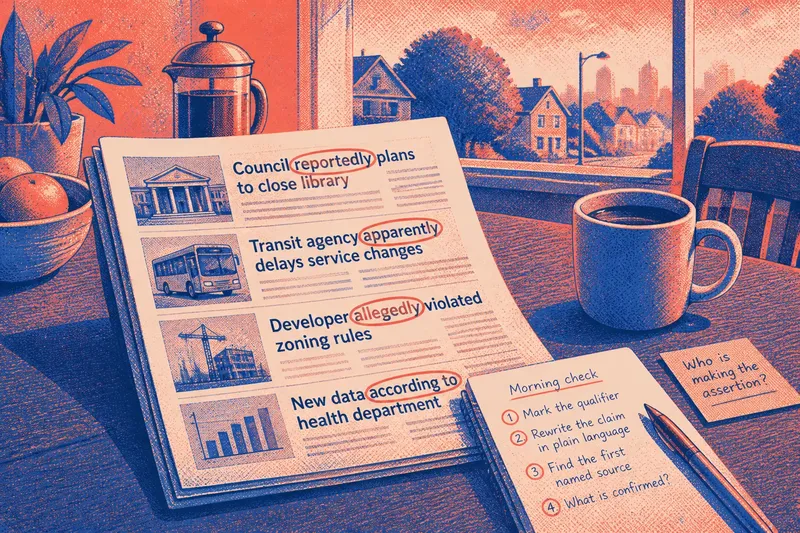
When a headline says a council reportedly plans to close a library, the word “reportedly” changes what the sentence claims. It tells you that the closure is being conveyed through a report, not necessarily asserted directly by the headline writer as settled fact. To read headlines carefully, notice the qualifying word, then ask who is doing the reporting and where the claim began.
That small pause matters because qualifying words can preserve uncertainty while still making a claim sound vivid and complete. “Apparently,” “allegedly,” “according to,” and “reportedly” do not all mean the same thing. Nor do they, by themselves, tell you whether a source is reliable. Their useful work is narrower: they signal some distance between the sentence and the assertion it carries.
What does a qualifying word actually qualify?
A qualifier adjusts the status or scope of a statement. In “The mayor reportedly rejected the proposal,” the headline presents a rejection as something reported, rather than simply stating, “The mayor rejected the proposal.” The added word leaves room for the possibility that the report is incomplete, disputed, or not independently confirmed by the outlet.
But “reportedly” does not identify the reporter. It might refer to a named newspaper, an official document, an anonymous source, or another outlet’s account. The headline has marked distance without yet explaining its source. That is a reason to keep reading, not a reason to assume the claim is false or true.
“Apparently” works differently. It commonly signals that something seems to be the case based on available signs or information. “The road is apparently closed” suggests an inference from what the writer or source can see or has been told. It does not necessarily point to a formal report. The word can soften a statement, but the basis for the impression may remain unstated.
“Allegedly” is often used for an accusation that has not been established as fact. It can mark the difference between saying someone committed an act and saying someone is accused of committing it. “According to” is more explicit about attribution, but only if the sentence names the person, institution, document, or outlet that follows it.
These words are not interchangeable safety padding. Ask what kind of distance each one marks: a report passed along, an apparent inference, an unproven allegation, or a claim attached to a named source. Then check whether the rest of the sentence keeps that distinction intact.
Who is making the assertion?
In a headline, the grammatical subject can distract from the actual source. “New rules reportedly affect renters” puts the rules in the foreground and leaves the report’s author out of view. The writer may be relying on a government notice, a tenant group, a news outlet, or a person familiar with a draft. Those are different paths to the same sentence.
Follow the attribution through the article. Look for phrases such as “the agency said,” “according to the filing,” or “the newspaper reported.” Note whether the source is identified by name and whether the article links to a document or original statement. If the source is described only as “people familiar with the matter,” the article is asking you to accept an account whose origin is partly concealed. That can be a legitimate reporting choice, but it limits what you can check from the page.
Also separate the source of the claim from the source of the headline. An outlet may report that another publication made an assertion; the headline may then use “reportedly” to carry it forward. The outlet has confirmed that the earlier report exists, which is not necessarily the same as confirming the underlying event.
Imagine a neighborhood paper publishes that a school district reportedly plans to combine two bus routes. You open the story and find that the claim comes from a parent’s email describing a draft schedule, while the district has not commented. The careful reading is not “the routes are being combined,” nor “the claim is baseless.” It is that a parent has described a draft plan, and the district’s position is not yet stated. The next useful question is whether the draft itself is available.
How should you read a qualifying word over a morning?
A short routine can make the distinction easier without turning every headline into an investigation. Try it during one ordinary news-reading morning, using the stories you already encounter. The point is to identify the chain of assertion, not to collect every possible source.
- On the first pass, mark the qualifier. As you scan a headline, mentally circle words such as “reportedly,” “apparently,” and “allegedly.” If there is no qualifier, note that too; a direct statement still needs a source.
- On the second pass, rewrite the claim plainly. Replace the headline’s flourish with a sentence that preserves the qualifier. “The company reportedly plans layoffs” becomes “A report says the company plans layoffs.” If you cannot name what the headline attributes, keep the claim provisional.
- When you open the story, find the first named source. Check the opening paragraphs for an official statement, a document, an eyewitness account, another outlet’s reporting, or an unnamed source. Record who is asserting the point, rather than treating the article itself as a single speaker.
- Before moving on, check what the story confirms directly. Does it link to a notice, quote a spokesperson, or say the outlet independently verified the detail? Keep that separate from what a source claims and what the headline implies.
Say you see “Transit agency apparently delays service changes” during breakfast. The story says riders noticed that a posted schedule still shows the old routes, but offers no agency statement. Your plain rewrite might be: “The schedule still shows the old routes; the article infers that the changes are delayed.” That is more precise than treating “apparently” as confirmation of an official decision.
In the same morning, you do not need to open every linked page or resolve every uncertainty. A useful result is a more accurate note to yourself: “A local outlet reports the agency may delay the change, based on the posted schedule; no agency confirmation is cited.” If you later share the story, that sentence helps prevent the headline’s cautious wording from disappearing in retelling.
What should you look for after the headline?
Once you reach the article, examine how the qualifier is handled in the body. A headline may say “reportedly,” while the first paragraph identifies a source and the next paragraph adds a response. That structure lets you see both the assertion and its status. If the body drops the qualification and states the disputed point as fact, ask whether it supplies evidence that supports the change.
Watch for a quiet shift in verbs. “A group alleges the contractor ignored a warning” attributes an accusation. “The contractor ignored a warning” states the act. A story may move between those versions as it describes documents, responses, and findings. Track who supports each sentence rather than assuming one attribution covers every detail.
Sources also have different relationships to a claim. A person who observed an event can speak to what they saw, but may not know what happened before or after. A spokesperson can confirm an organization’s stated position, but that statement does not automatically settle a contested account. A document can show what it records; it may not show why an action occurred. These limits do not make sources useless. They show what kind of assertion each source can support.
Pay attention to whether an article distinguishes between a source’s words and the outlet’s own reporting. “The company said the product is safe” reports the company’s position. It does not mean the outlet independently established that conclusion. Likewise, “according to a court filing” identifies a document as the source of a claim; it does not mean a court has accepted that claim as true.
Where an article links to an original statement or document, open it if the claim matters to you. Check whether the headline accurately reflects the wording and whether important conditions appear nearby. A short excerpt can leave out qualifications that are visible in the full statement. You are checking the claim’s route, not trying to turn yourself into a specialist in every subject.
Which questions help distinguish the words?
Does “reportedly” mean the claim is confirmed?
No. It signals that a report is being relayed, but does not identify the report’s evidence or establish the underlying event. Find the source named in the article and note what that source can actually support.
Is “apparently” stronger than “reportedly”?
Not by itself. “Apparently” often presents an inference from available signs, while “reportedly” points toward an account attributed to reporting. The surrounding sentence and the source matter more than an imagined ranking of the two words.
What does “allegedly” tell me?
It marks an assertion as an allegation rather than an established fact, especially in accounts of disputed or potentially wrongful conduct. Check who made the allegation, whether the subject responded, and whether a relevant process has reached a finding.
Can “according to” settle who is responsible for a claim?
It helps when the sentence names its source, such as a report, official, or document. It still does not establish whether that source is accurate or whether the claim goes beyond what the source says.
When does cautious wording still mislead?
A qualifier can be technically present and still leave a misleading impression. A headline may put a dramatic allegation in its main clause, then tuck “reportedly” into a position readers are likely to skim past. The word reduces certainty, but the strong image of the accusation may remain. Read the whole sentence and ask what impression a reader would carry into the article.
Attribution can also be vague. “Officials reportedly expect a change” leaves open which officials, how many, and whether they speak for the organization involved. “A change is reportedly coming” removes even that much. Such wording is not proof of bad faith, but it gives you little basis for assessing the source chain. The article should provide more detail if the claim is central.
There is another common slippage: a cautious qualifier in the headline may be repeated as certainty in a social post, a group chat, or a later summary. Each retelling can remove a layer of attribution. If you pass along a claim, keep the source attached: “The outlet reports, citing a draft notice, that the route may change” is less compact than “The route is changing,” and more faithful to the information at hand.
Sometimes the article itself cannot resolve the point. A source may decline to comment, a document may be incomplete, or different accounts may conflict. In that case, leave the claim open rather than forcing a verdict. You can still know who said what, what was directly confirmed, and which parts remain uncertain.
What is the useful habit to keep?
Make the qualifier the start of a small attribution check. Identify the person, organization, document, or outlet behind the assertion; separate that source’s statement from the article’s own confirmation; and preserve any uncertainty when you repeat the claim. This takes little effort once the words stop blending into the headline.
For a headline containing “reportedly,” the most useful follow-up is often simple: reported by whom, on what basis, and with what confirmation? That question will not settle every story. It will keep you from mistaking a report about a claim for proof of the claim itself.