A Developing Story, Read in Three Passes
A developing story is easier to read without filling its gaps: use three passes to separate confirmed details, track changes, and choose when to check again.
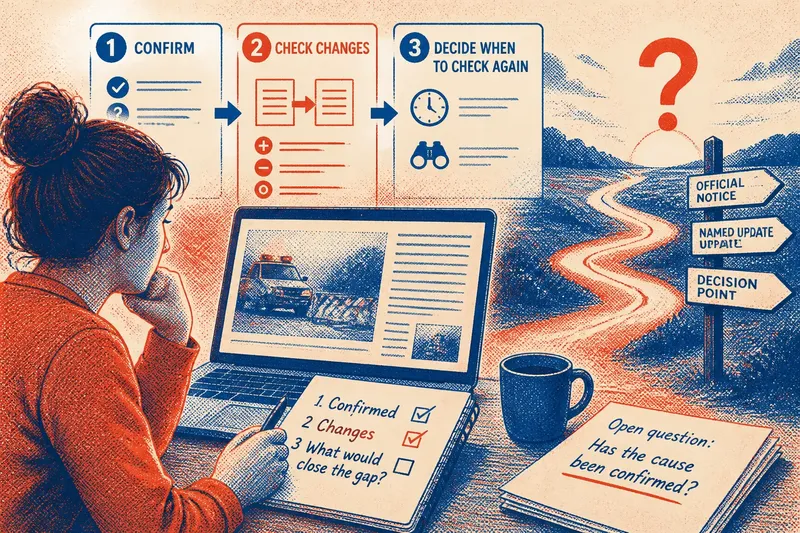
A developing story can leave one detail unresolved while the headline sounds settled. Read it in three passes: mark what is confirmed, check what has changed, then decide whether an explicit update has closed the gap. The routine is not a hunt for certainty. It is a way to keep an unanswered question from quietly turning into a fact.
What does each pass do?
The three passes answer different questions. Mixing them together makes an update feel more complete than it is.
- Pass one: What does this report actually confirm? Read the body, not only the headline or push alert. Note the specific claims the report states as established, and keep questions, forecasts, and attributed claims separate.
- Pass two: What has changed since the last report? Compare the current account with an earlier version from the same outlet. Look for newly added facts, corrected details, changed attribution, and wording that remains unchanged.
- Pass three: What would count as an update? Name the open question and the sort of explicit information that could answer it. Until that appears, leave the answer open.
These passes are a bounded routine, not a demand to keep refreshing. A reader can stop after identifying the state of the report and choose a reasonable point to look again, if there is a reason to do so.
Which reading approach suits you?
There are three useful ways to apply the routine. Choose according to the story’s importance to you and whether the next update could change a decision. More checking is not automatically better; sometimes it only supplies fresh wording around the same missing detail.
Use a quick pass when you need orientation
Read the current article once and identify its firmest claims and its clearest open question. This suits a reader who wants to understand what is known without following every update. It is also sensible when the report is interesting but has no immediate bearing on a choice you need to make.
Say you see a local alert about a road closure, and the report says crews are investigating a cause but does not name one. You note that the closure is reported and that the cause remains unresolved, then stop rather than infer a crash or a hazard. The observable result is a more accurate account of what you know, not a solved story.
Use a comparison pass when versions differ
Open the same outlet’s earlier article or update and compare the language. This suits a reader who has seen multiple alerts, noticed a changed headline, or needs to know whether a detail is new. A browser history entry, a saved link, or a simple note with the time and wording can help; you do not need a sprawling spreadsheet.
Compare like with like. A headline may be revised for clarity while the body gains no new reporting. Conversely, a short update may add a meaningful detail even if the headline stays put. Look for the substance: what is newly stated, what has been corrected, and what the report still attributes to an official, witness, or other source.
Use a decision-focused pass when the gap affects an action
If the report could affect travel, work, or another practical choice, identify what information would change your next move. Then look for that information in a relevant official notice or a clearly updated report, rather than treating an unanswered news question as a cue to guess. This approach suits situations where a missing detail matters more than the story’s full explanation.
For immediate safety decisions, rely on instructions from appropriate local authorities and follow any applicable professional guidance. A developing article may be useful context, but it is not a substitute for a direct alert about what to do.
How can you compare versions without overreading them?
Use a small change log, even if it is only a note in your phone. Record the article’s outlet, the time you read it, and the specific detail that appears to have changed. Avoid copying a whole stream of updates; the point is to notice changes, not to become the story’s unpaid archivist.
When comparing, separate four kinds of change:
- New information: a detail is added and attributed to a source.
- Correction: an earlier detail is replaced or withdrawn.
- Clarification: wording is made more precise without necessarily changing the underlying account.
- No material change: the article’s central facts and open questions remain the same.
A timestamp alone does not tell you which kind occurred. If the page has an update note, read it. If not, compare the relevant paragraphs rather than assuming every fresh timestamp signals new evidence. Also notice whether a detail has moved from a question in the headline to a firm statement in the body, or the reverse; that shift deserves attention, but the actual wording and attribution decide what it means.
When should you check again?
Choose a stopping point before opening another tab. You might return when the outlet posts a named update, when an official source publishes a notice relevant to the open question, or when you next need to make a decision. The right cue depends on the story; a vague sense that “something must have happened by now” is not a cue.
Keep the open question in plain language. “Has the cause been confirmed?” is more useful than “What is really going on?” The narrower question makes it easier to see whether an update answers it, partially addresses it, or says nothing about it.
What should you do with an unanswered detail?
Leave it visibly unanswered. A useful note can be as simple as: “The report confirms the closure; it does not identify the cause.” That sentence resists two common temptations: borrowing an explanation from a different incident and treating repeated speculation as confirmation.
Do not let a later article settle the question by implication. If it reports a consequence without stating the cause, the cause remains open. If it quotes a source making a claim, the report establishes that the source made the claim; whether the claim itself is confirmed depends on what the article says and how it supports it.
What questions help you read a developing story?
How can I tell whether a story has actually changed?
Compare the current body with an earlier version and identify a concrete new, corrected, or clarified detail. A revised headline or new timestamp by itself does not establish that the account has materially changed.
Should I trust a live update more than a full article?
Neither format is automatically more reliable. Read the update’s specific claim and attribution, and check whether it adds information or merely repeats an earlier point in shorter form.
What if two outlets report different details?
Keep both claims attributed to their respective reports and identify exactly where they differ. Look for a direct correction or explicit resolution before treating one version as settled.
When is it reasonable to stop checking?
Stop when another update is unlikely to affect your understanding or next decision, or when you have reached the cue you set for checking again. You can return if a relevant update appears; an open question does not require continuous attention.
How do you choose among the three passes?
Use the quick pass for orientation, the comparison pass when the account seems to shift, and the decision-focused pass when an unresolved detail could affect an action. A story may call for more than one, but none requires you to treat every new alert as a new answer.
The useful habit is simple: state what the report confirms, notice what changed, and leave the remaining gap open until an explicit update addresses it. For a developing story, that is enough to read carefully without appointing yourself the editor of every unanswered sentence.