Document, Witness, or Secondhand Account?
Document, witness, or secondhand account: learn what each source can establish, what it leaves open, and which attribution details help you judge a claim.
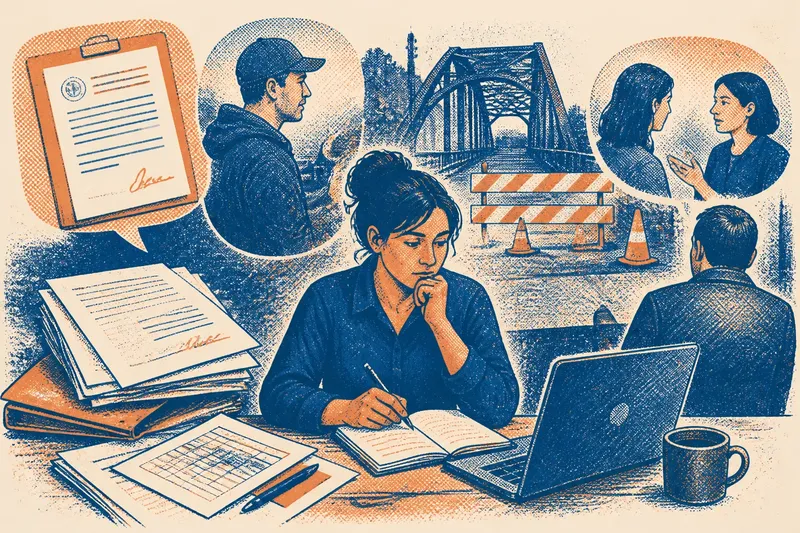
A report says a city office closed a bridge, and the sentence cites a document, a witness, and a person who heard about the decision from someone else. To judge the claim, start with the source type: a document, witness, or secondhand account can each support a different part of the story. The useful question is not which one is automatically trustworthy. It is what each source had access to, and what remains outside that access.
Sources are not interchangeable containers of truth. A signed memo may establish what an office recorded, but not whether staff followed it. A witness may describe what they saw, but not what happened outside their view. A secondhand account may point toward someone with direct knowledge, while leaving a gap between that person and the reader. Sorting those limits helps you read a claim without either dismissing it or granting it more reach than it has.
What does a document establish?
A document can establish that a particular record exists and that it contains particular words, dates, or decisions. Depending on its origin, it may also show what an organization formally approved, reported, requested, or received. Examples include a court filing, an agency notice, meeting minutes, a company email, a contract, or a spreadsheet released with a news story.
But a record proves its own contents more readily than it proves the surrounding event. An internal email saying a bridge was closed may show that an employee wrote those words. It does not by itself establish that barriers went up, that the public was notified, or that the closure lasted as described. A draft can differ from the final version; minutes can omit disagreement; a spreadsheet can reflect a chosen definition rather than a complete count.
When an article cites a document, look for the details that let you identify its place in the chain:
- Origin: Who created or issued it, and in what role?
- Type and status: Is it a final order, draft, filing, transcript, record excerpt, or summary?
- Date and scope: When was it made, and what period, event, or group does it cover?
- Access: Can you open the record, see an image of it, or read only a reporter’s description?
- Completeness: Are attachments, surrounding pages, definitions, or later revisions missing?
- Connection to the claim: Does the document state the claim directly, or is the article drawing an inference from it?
These clues matter because institutional form can look more conclusive than it is. A stamped document may be authentic and still contain an allegation, an estimate, or a statement from a person whose account has not been independently checked. A news story should distinguish what the record says from what the reporting says it means.
Say you see a story citing a transit agency notice about a bridge closure. The notice names a planned closure window but does not say whether crews put barricades in place. You can reasonably conclude that the agency announced a plan; to establish what travelers encountered, you would need a source with access to the actual closure, such as a direct witness or operational record.
When is a witness the right source?
A witness is most useful for what they directly perceived: a sound, a conversation they heard, a vehicle they saw, or an action they watched. Direct observation can make a specific event vivid and help establish sequence or location. It does not make a witness omniscient. People see from a position, remember selectively, and may not know the names, motives, or earlier events connected to what they observed.
For a witness-based claim, ask what the person could actually perceive. Were they present at the scene? Did they see the event, hear it, or learn about it afterward? Could distance, noise, lighting, obstruction, or a brief view limit what they noticed? Is the account made in the witness’s own words, or paraphrased by a reporter? These are not accusations. They define the boundaries of the account.
Attribution should also tell you enough to judge the source’s position without pretending a name is the same as proof. A report may identify a witness by name and explain their role, such as a nearby shop owner or a person waiting at the bus stop. If the name is withheld, the story should usually give a meaningful reason and relevant description. “A witness said” supplies little about access; “a person who was standing beside the entrance said they saw the gate close” tells you more about what the account can cover.
One witness can establish that they report seeing something. A second, independent witness may strengthen the account, especially if each had a separate vantage point. But several people repeating the same original account are not several independent observations. Check whether sources describe what they personally saw or merely confirm a story already circulating.
What changes when an account is secondhand?
A secondhand account reaches you through an intermediary. A neighbor tells a reporter what a friend said; an official summarizes what a contractor reported; a post repeats an assertion from another post. The intermediary may be accurate, but each link creates a chance for wording, context, or uncertainty to shift.
Secondhand information can still be useful. It may identify a lead, explain how a claim reached an organization, or show what someone understood at a particular time. It is weaker support for the underlying event unless the story makes the chain clear and connects it to a source with direct knowledge or an independently checkable record.
Look for the chain itself. Who first made the claim? Who relayed it? Did the reporter speak to the original source, or only to an intermediary? Is the intermediary in a position to know, and does the account preserve the original speaker’s uncertainty? “A spokesperson said a contractor reported seeing smoke” is not equivalent to “a witness saw smoke.” The first statement identifies a relayed report; the second claims direct observation.
Anonymous sourcing needs particular care here. An article may withhold a source’s identity to protect them, but the reader should still be given useful context: the source’s relationship to the event, whether they have direct access, why anonymity was granted, and whether the information was corroborated. If the story gives none of that, you cannot evaluate the source’s access or incentives well. Treat the claim as less transparent, not automatically false.
Which source fits the claim you are reading?
Match the source to the exact verb in the claim. “The agency issued an order” calls for an authentic order or a reliable account of its issuance. “The gate was closed” calls for evidence about what happened on the ground. “Officials knew the gate was closed” raises a further question about who was told, when, and how that knowledge can be shown. A source that supports one sentence may not support the next inference.
- If the claim concerns what was formally recorded or decided, start with the original document and check whether it is final, complete, and accurately described.
- If the claim concerns what a person saw or heard, look for a direct witness account and details of the person’s position, timing, and opportunity to observe.
- If the claim arrives through someone else, trace the relay and distinguish the intermediary’s knowledge from the original speaker’s.
- If the claim joins a record to an event, look for both kinds of support rather than expecting either one to do both jobs.
- If a source is anonymous or described vaguely, note what the story says about access, reason for anonymity, and corroboration; keep your confidence proportionate to those details.
These are practical choices, not a ranking from best to worst. A signed document can be poor evidence for an event it only planned. A witness can be a strong source for what happened within view and a weak one for what caused it. A secondhand account can direct attention to a useful lead, but its relay should not disappear from the wording.
What should you check about attribution?
What does “according to a document” mean?
It should identify the kind of record and, ideally, its issuer or author. Check whether the article quotes the record directly, summarizes it, or infers a broader claim from a narrow passage.
How can I tell whether a witness had direct access?
Look for where the witness was, what they perceived, and whether the account is firsthand. A clear description of the vantage point helps you separate observation from interpretation.
What if the source is anonymous?
Look for the person’s relevant role, the reason the name is withheld, and whether the account is independently supported. If those details are absent, the source’s identity and access are harder to assess.
How do I spot a secondhand account?
Watch for phrases such as “was told,” “according to a person familiar with,” or “a spokesperson said someone reported.” Then ask who supplied the original information and whether the intermediary personally knows the underlying facts.
How should you read a story with mixed sources?
Many reports combine records, interviews, and relayed statements. That can be sensible: one source may show what was planned, another what occurred, and another how an organization responded. The important thing is whether the article keeps those roles visible instead of blending them into one smooth, overconfident narrative.
Read each key sentence and ask what kind of support it needs. Separate the stated fact from the reporter’s interpretation. Note where the account changes from a document’s wording to a witness’s observation, or from a witness’s observation to an explanation supplied by someone else. If a claim rests on several links, the wording should preserve the chain rather than hide it.
For a quick source check, write down the claim in plain language, then mark whether its support is documentary, firsthand, or relayed. Add one unresolved question beside it: what does this source not establish? That small pause is often enough to prevent an official record from standing in for an event, a witness from standing in for the whole scene, or a repeated account from sounding like independent confirmation. For document, witness, or secondhand account, the right choice is the one that matches the claim’s scope and makes its limits visible.